El Paso Tunnels
Aaron Perez
11/06/2026
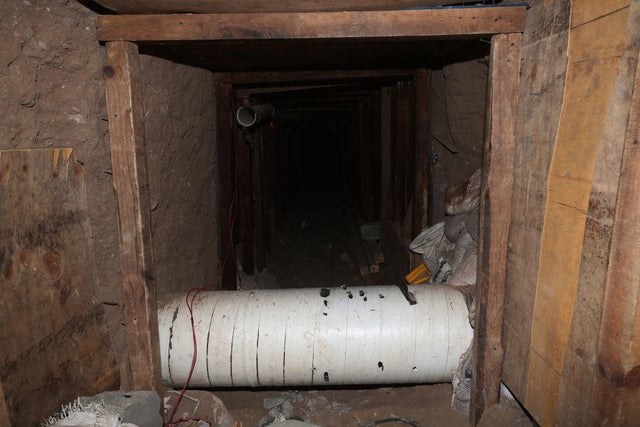
El Paso sits on a fault line of history. Above ground, the Franklin Mountains, the sun-bleached streets of Sunset Heights, the steady flow of the Rio Grande. Below, a quieter network of passages, basements, and sealed corridors has long fed local legend. Some are real. Some are exaggerated. A few still turn up when construction crews dig too deep or Border Patrol teams sweep the storm drains. Together they form one of the city’s most enduring mysteries.
The Chinese Exclusion Act and the Underground Railroad of the Southwest
The most substantive origin story begins in the 1880s. Chinese laborers arrived with the railroad in 1881. When the Chinese Exclusion Act of 1882 barred further immigration, a well-organized smuggling system grew between Ciudad Juárez and El Paso. Historians, including researcher Nancy Farrar and local chronicler Leon Metz, describe an informal “underground railroad”: safe houses, English lessons in Juárez to help new arrivals blend in, and tunnels or connected basements that let people move without crossing the open border in daylight.
El Paso’s Chinatown—roughly the area bounded by Mills, Stanton, El Paso, and Fourth streets—became a hub. Opium dens, gambling houses, markets, and laundries shared the same blocks. Some buildings were said to contain hidden compartments in floors and walls. Claims of tunnels running under the river itself appear in period immigration reports; the physical difficulty of tunneling under the shifting Rio Grande makes long continuous passages unlikely, but shorter connections between houses and dens were more plausible.
The Turtle House and Sunset Heights
The best-known remnant sits at 516 Corto Way in Sunset Heights. The Turtle House (once nicknamed the Ghost House) has a multi-room brick basement with arched ceilings, a fireplace, and visible sealed tunnel openings. A turtle motif on the exterior has been interpreted by some as a Chinese symbol of safe haven. Residents and tour groups have explored the lower levels; the passages themselves are closed. Folklore links the site to Chinese smuggling, munitions storage during the Mexican Revolution (including possible use by Pancho Villa’s supporters), and even Catholic refugees during later conflicts. Skeptics note that some “tunnels” may simply be drainage or structural spaces. Either way, the basement remains one of the few places where the legend is still tangible.
Prohibition, Revolution, and Everyday Use
Once dug or adapted, the spaces found new purposes. During Prohibition, basements and passages in Chihuahuita and downtown reportedly stored liquor. During the Mexican Revolution, some were said to hide arms or people. Later, the city’s extensive storm-drain system—built for desert flash floods—became its own subterranean highway. Modern Border Patrol teams still work those drains; sophisticated, recently built tunnels equipped with ventilation and lighting continue to appear and are shut down when found.
El Paso High School has its own network of tunnels, originally part of the heating and ventilation system. They have acquired a thick layer of ghost lore: claims of sealed classrooms, footsteps, cold spots, and stories that the spaces served as temporary morgue overflow during the Spanish Flu or World War II. The combination of dark corridors and institutional history makes them a natural magnet for local paranormal interest.
Legend Versus Evidence
Local historians such as Ken Hudnall have spoken of vast networks—hundreds of miles in the more dramatic tellings. Documented finds are more modest: short passages, interconnected basements, utility corridors, and the occasional cross-border tunnel. Many downtown buildings share old infrastructure. Property owners are understandably reluctant to open everything for exploration; structural risk is real. The result is a classic borderland situation: enough physical evidence and historical motive to keep the stories alive, not enough continuous mapping to settle every claim.
Why the Tunnels Still Matter
The passages under El Paso are less a single grand conspiracy than a layered record of exclusion, adaptation, and survival. Chinese laborers barred by law found ways around it. Bootleggers, revolutionaries, and later smugglers reused the same logic of moving out of sight. The modern storm drains and occasional cartel tunnels are the latest chapter in a much older pattern.
For a city that lives with the border every day, the underground is both practical and mythic. It is the place where official history and oral history blur—where a sealed brick archway can still feel like a door into another century. Whether you approach it as local history, urban exploration, or the kind of atmospheric setting that fuels horror and folklore, the tunnels remain one of El Paso’s most compelling unfinished stories. The surface city keeps changing. Underneath, the older routes wait, quiet and sealed, for the next time someone digs too deep.
Sources:
Farrar, Nancy. The Chinese in El Paso. Texas Western Press, 1972. Southwestern Studies, monograph no. 33.
Long, Trish. “Turtle House Was Once Called ‘Ghost House,’ Used by Young Thieves.” El Paso Times, 16 Aug. 2017, www.elpasotimes.com/story/life/2017/08/16/turtle-house-once-called-ghost-house-used-young-thieves/574696001/.
“The Remnants of Tunnels under El Paso’s Streets Tell the Origins of Human Smuggling.” Borderzine, 27 Dec. 2012, borderzine.com/2012/12/the-remnants-of-tunnels-under-el-pasos-streets-tell-the-origins-of-human-smuggling/.
Chávez, Adriana M. “Mysterious Tunnels.” El Paso Times, 26 Mar. 2007. Reprinted in USA Today “Tales from the Morgue,” eu.usatoday.com/story/news/history/blogs/tales-from-the-morgue/2012/04/27/2007-mysterious-tunnels/31509621/.
Timmons, W. H. El Paso: A Borderlands History. 2nd ed., Texas Western Press, 1990.
Staski, Edward. Beneath the Border City: The Overseas Chinese in El Paso. New Mexico State University, 1985.
Bogan, Ray. “Border Patrol Agents Find Tunnel in El Paso That Connects City to Storied Past.” Fox News, 30 Jan. 2018, www.foxnews.com/us/border-patrol-agents-find-tunnel-in-el-paso-that-connects-city-to-storied-past.
Metz, Leon. El Paso: Guided through Time. Mangan Books, 1999.


Comments
Post a Comment