October 1st- Nosferatu (1922, 1979, and 2024 versions)
Aaron Perez
10/1/2026
There is a particular kind of nightmare that refuses to stay buried. It rises from the Carpathian darkness, sails across black waters on a plague ship, and slips into the quiet bedrooms of provincial towns. Its name is Nosferatu, and for more than a century it has stalked the history of cinema.
F.W. Murnau’s Nosferatu: A Symphony of Horror (1922) remains one of the purest expressions of cinematic dread ever committed to film. Werner Herzog’s Nosferatu the Vampyre (1979) answered it with a melancholy, almost philosophical variation. Robert Eggers’ Nosferatu (2024) returned to the source with feverish intensity, eroticism, and a near-religious devotion to atmosphere. Together they form a strange, unbroken lineage—three films that are both remakes and original acts of possession.
The Unauthorized Masterpiece: 1922
In the aftermath of the First World War and the Spanish flu pandemic, German cinema turned toward the grotesque and the expressionistic. Albin Grau, an occultist and artist who claimed to have heard vampire stories from a Serbian farmer during the war, founded the short-lived Prana-Film specifically to make supernatural pictures. Its only production was Nosferatu.
The film is an unauthorized adaptation of Bram Stoker’s Dracula. Character names were changed—Count Dracula became Count Orlok, Jonathan Harker became Thomas Hutter, Mina became Ellen—yet the plot remains unmistakable. Florence Stoker, the author’s widow, sued successfully. Courts ordered every print and negative destroyed. Prana-Film went bankrupt. A handful of prints survived abroad, and the film that was meant to be erased became immortal.
Max Schreck’s Orlok is not the elegant aristocrat of later Draculas. He is a walking corpse: bald, pointed ears, rat-like teeth, elongated fingers, a body that seems to have been assembled from the wrong parts. When he rises stiffly from his coffin or stands in a doorway with his shadow stretching impossibly across a wall, the image sears itself into memory. Murnau and cinematographers Fritz Arno Wagner and Günther Krampf used real locations—Wismar for the German town of Wisborg, Orava Castle in Slovakia for Orlok’s lair—and innovative techniques: negative film for the spectral coach ride, stop-motion for the rising coffin, stark lighting that turns ordinary architecture into something alien.
The story is simple and pitiless. Young real-estate agent Hutter is sent by his eccentric employer Knock to Transylvania to close a deal with the reclusive count. Orlok becomes obsessed with Hutter’s wife Ellen after seeing her portrait. He travels by sea to Wisborg, bringing plague rats and death. Ellen discovers from an old book that only a pure-hearted woman who willingly keeps the vampire until sunrise can destroy him. She sacrifices herself. The sunlight claims Orlok. The plague ends.
What makes the film endure is not jump scares but atmosphere and mythic clarity. It links the vampire to disease, to the contamination of the familiar, to the idea that evil can arrive by ordinary ship and take root in ordinary streets. In a Germany still reeling from war and epidemic, the metaphor was immediate.
Herzog’s Phantom of the Night: 1979
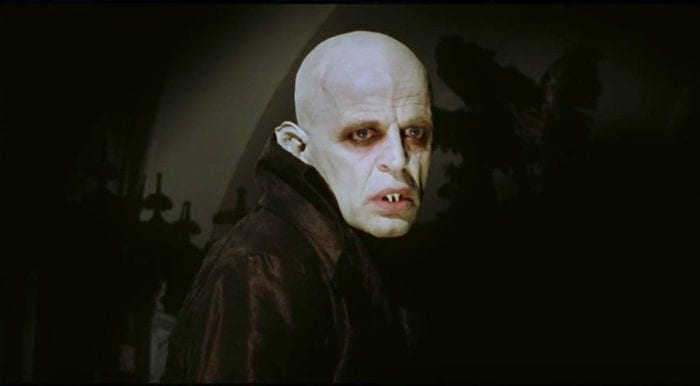
Nearly sixty years later, Werner Herzog decided the film needed to be answered rather than merely repeated. Nosferatu the Vampyre (often dated 1979, though sometimes loosely referred to earlier) is both homage and critique. Because Stoker’s novel had entered the public domain, Herzog restored the original names: Count Dracula, Jonathan Harker, Lucy Harker. Klaus Kinski, Herzog’s frequent and volcanic collaborator, played the vampire.
Kinski’s Dracula is still recognizably Orlok—pale, clawed, rat-toothed—but he is also exhausted, almost tragic. He speaks of the loneliness of centuries, of the curse of immortality. Where Schreck’s creature is pure otherness, Kinski’s is a suffering consciousness trapped in a decaying body. Isabelle Adjani’s Lucy is luminous and resolute; Bruno Ganz’s Jonathan is gradually broken by the experience. The film was shot in both German and English versions, with Herzog preferring the German as more authentic.
Herzog brought thousands of rats to the Dutch town of Delft (standing in for Wismar) and filmed in the same Slovakian landscapes. The result feels less like German Expressionism and more like a documentary of the uncanny. Nature itself seems diseased. The plague is not merely a plot device; it is the physical manifestation of Dracula’s presence. The ending diverges sharply: Lucy destroys the vampire at the cost of her own life, but Jonathan, already transformed, rides off into the world to continue the contagion. Evil is not neatly defeated. It simply changes hosts.
Herzog described the project as an attempt to reconnect with the great German cinema of the 1920s after the rupture of Nazism and the war. The film is slower, more contemplative, and deeply sad. It treats the vampire myth as a meditation on isolation, time, and the indifference of nature.

Eggers’ Fever Dream: 2024
Robert Eggers had wanted to remake Nosferatu since early in his career. After The Witch, The Lighthouse, and The Northman, he finally did. The 2024 film is a passion project executed with almost fanatical precision: period-accurate costumes, practical effects, meticulously researched folklore, and a visual language that feels both modern and ancient.
Bill Skarsgård’s Count Orlok is a monumental, heavily prosthetic creation—mustached, decayed, with a voice like rotting meat. He is less rat-like than Schreck’s and less pitiable than Kinski’s; he is ancient appetite given form. Lily-Rose Depp’s Ellen is the true center of the film. In a significant departure, Eggers opens with a young Ellen psychically summoning the creature in a moment of lonely desperation. Their connection is not accidental; it is reciprocal, erotic, and destructive. Nicholas Hoult’s Thomas Hutter is earnest and increasingly powerless. Willem Dafoe, who once played Max Schreck in Shadow of the Vampire, appears as the eccentric occultist Professor von Franz, a Van Helsing figure who understands the true nature of the threat.
Eggers expands the supporting characters—Aaron Taylor-Johnson and Emma Corrin as the Hardings receive more weight—and leans hard into the psychosexual undercurrents that earlier versions only suggested. The film is longer, denser, and more explicit about desire, possession, and the cost of confronting one’s own darkness. Plague rats still arrive by ship. Shadows still stretch across walls. The final confrontation retains the original’s sacrificial logic, but the emotional texture is richer and more ambiguous.
Critics largely praised the film’s craftsmanship, atmosphere, and Depp’s physically intense performance. It became Eggers’ highest-grossing work and earned Academy Award nominations for its technical achievements. Some found it overly reverent or slower than expected; others saw it as a near-perfect synthesis of the 1922 original’s nightmare logic and contemporary gothic sensibility.
Three Shadows, One Myth
The three films form a conversation across a century.
Murnau’s version is pure Expressionist nightmare—sharp, silent, mythic. Herzog’s is a melancholic elegy, concerned with time, nature, and the persistence of evil. Eggers’ is a feverish, tactile, erotic possession narrative that makes Ellen’s interior life the engine of the story.
All three treat the vampire as something more than a monster. In 1922 he is plague and foreign contamination. In 1979 he is the loneliness of eternity. In 2024 he is the dark mirror of suppressed desire and the price of agency. The visual signatures recur—elongated shadows, the ship of the dead, the woman who willingly offers herself to the sunrise—but each director uses them for different ends.
What is remarkable is how little the core image has needed updating. Orlok still looks wrong. The architecture still feels like it is leaning toward you. The idea that something ancient and hungry can enter the modern world through the ordinary channels of commerce and travel still carries force. In an age of new pandemics, new isolation, and new anxieties about contamination—bodily, cultural, digital—the shadow remains relevant.
Nosferatu does not die. He is invited, he arrives, he feeds, and when the pure-hearted (or the desperate, or the resigned) finally confront him, the cycle only pauses. The prints that survived the destruction order in the 1920s, the rats that flooded Herzog’s set, the prosthetics that turned Skarsgård into a living corpse—all of them testify to the same truth: some nightmares prefer to be remade rather than forgotten.
A century after Max Schreck first stepped into the light (and out of it), the Symphony of Horror is still playing. The only question is which version of the music you choose to hear when the shadows lengthen.
Sources:
“Nosferatu.” Encyclopædia Britannica, Encyclopædia Britannica, Inc., 5 Oct. 2023, www.britannica.com/topic/Nosferatu-film-by-Murnau-1922.
“Nosferatu (1922 film).” Wikipedia, Wikimedia Foundation, 2026, en.wikipedia.org/wiki/Nosferatu_(1922_film).
“Nosferatu (2024 film).” Wikipedia, Wikimedia Foundation, 2026, en.wikipedia.org/wiki/Nosferatu_(2024_film).
“Nosferatu the Vampyre.” Wikipedia, Wikimedia Foundation, 2026, en.wikipedia.org/wiki/Nosferatu_the_Vampyre.
Ebert, Roger. “Nosferatu the Vampyre.” RogerEbert.com, 24 Oct. 2011, www.rogerebert.com/reviews/great-movie-nosferatu-the-vampyre-1979.
Eggers, Robert, director. Nosferatu. Focus Features, 2024.
Herzog, Werner, director. Nosferatu the Vampyre. Werner Herzog Filmproduktion / Gaumont, 1979.
Murnau, F. W., director. Nosferatu: A Symphony of Horror. Prana-Film, 1922.
Rooney, David. “‘Nosferatu’ Review: Bill Skarsgard and Lily-Rose Depp Are Riveting, but Director Robert Eggers Rules This Haute-Horror Feast.” The Hollywood Reporter, 2 Dec. 2024, www.hollywoodreporter.com/movies/movie-reviews/nosferatu-review-bill-skarsgard-lily-rose-depp-nicholas-hoult-robert-eggers-1236074321/.
“Why 1922’s Nosferatu Is One of the Most Influential Horror Movies Ever Made.” Empire, 19 Dec. 2024, www.empireonline.com/movies/features/why-1922-nosferatu-most-influential-horror-movies/.
Bradshaw, Peter. “Nosferatu Review – Robert Eggers’s Respectful Homage to a Vampire Horror Classic.” The Guardian, 2 Dec. 2024, www.theguardian.com/film/2024/dec/02/nosferatu-review-robert-eggers-lily-rose-depp-bill-skarsgard.
“Nosferatu (2024).” Rotten Tomatoes, Fandango Media, 2024, www.rottentomatoes.com/m/nosferatu_2024.


Comments
Post a Comment