Night of the Living Dead and Romero Zombies- October 10th
Aaron Perez
10-10-2026

Night of the Living Dead (1968) launched the modern zombie as we know it: slow-moving, flesh-eating reanimated corpses that overwhelm society, forcing survivors into desperate barricades while exposing human flaws. Directed and co-written by George A. Romero (with John A. Russo), the low-budget black-and-white film follows a group trapped in a Pennsylvania farmhouse during the early stages of an unexplained outbreak of “ghouls.” It mixed tight tension, shocking violence for its era, progressive casting (Duane Jones as the resourceful lead Ben), and social commentary on racism, media, and breakdown of order. The film entered the public domain due to a missing copyright notice after a last-minute title change, which helped its cultural spread even as it complicated profits for the creators.
Romero’s zombies (often called “Romero zombies”) became the template: mindless or near-mindless, driven by a hunger for living flesh, typically slow and shambling, vulnerable to destruction of the brain or severe head trauma, and spreading via bites or death from any cause in the outbreak. The cause was left mysterious (hints of radiation from a Venus probe in the original), and the horror came as much from human conflict and societal collapse as from the undead. Romero directed five official sequels that expanded this universe with evolving social satire:
- Dawn of the Dead (1978): Survivors hole up in a shopping mall as the apocalypse spreads. A sharp critique of consumerism—zombies return to the mall out of residual instinct—while delivering bigger action, gore, and dark humor. Many consider it Romero’s peak.
- Day of the Dead (1985): Months later, scientists and soldiers clash in an underground bunker over how to study or eradicate the undead. Bleaker and more claustrophobic, it explores military-civilian tension and the possibility of residual intelligence in zombies (notably Bub).
- Land of the Dead (2005): Years into the apocalypse, a fortified city of the wealthy is threatened by evolving zombies who show organization and learning. Class warfare and inequality take center stage.
- Diary of the Dead (2007): A found-footage style look at the early outbreak through film students documenting events, commenting on media and digital-age documentation.
- Survival of the Dead (2009): Romero’s final film focuses on feuding families on an island, using the undead to examine endless conflict and inability to let go of old grudges.
These films form a loose continuity of societal decline rather than a tight character saga. Romero dropped “Living” from the titles after the original partly due to rights arrangements with Russo. A concluding project, Twilight of the Dead, based on Romero’s ideas, has been in development.
The Split and Return of the Living Dead
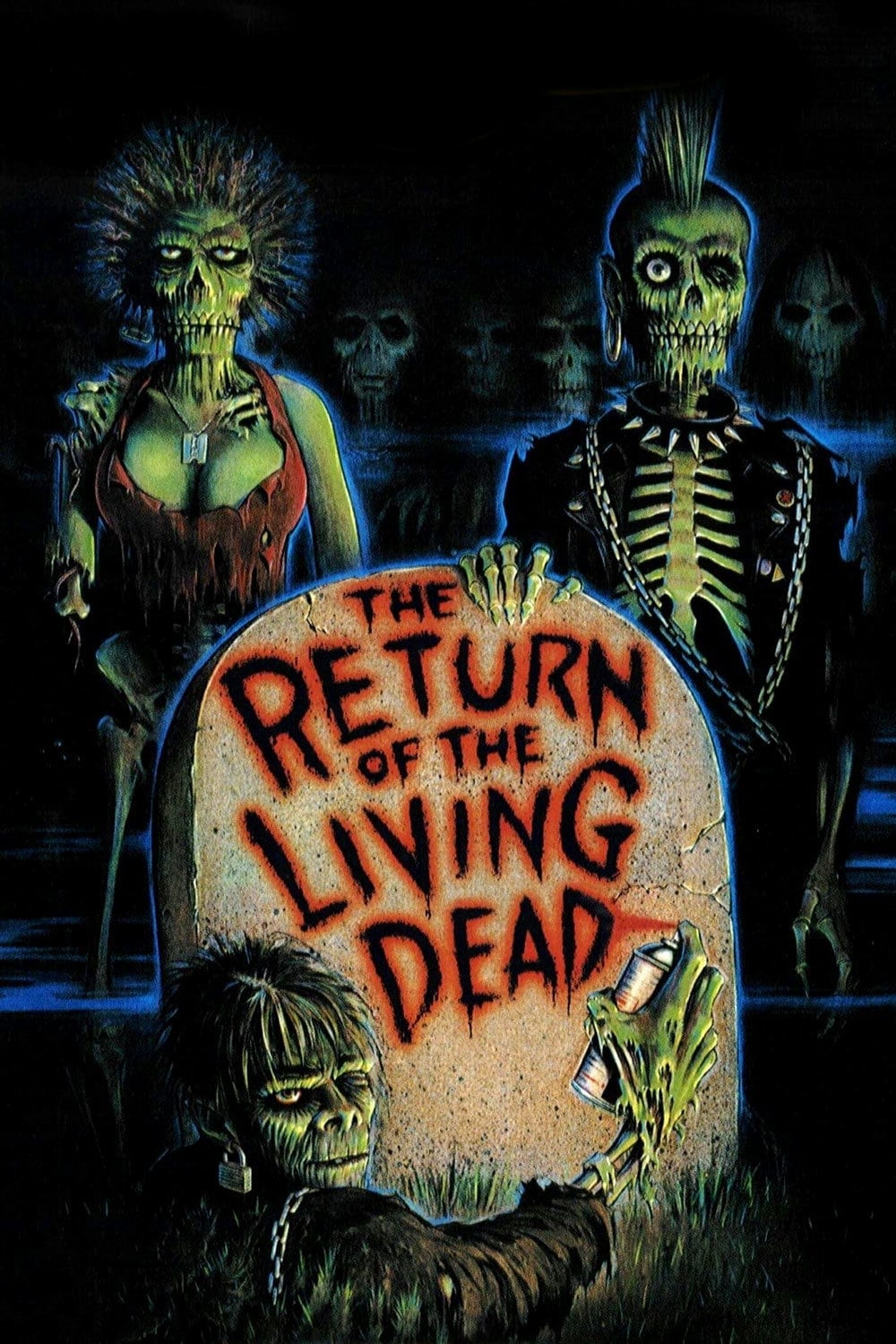
After Night of the Living Dead’s success, Romero and Russo disagreed on the direction of sequels. They reached an agreement: Romero would continue with “...of the Dead” films, while Russo retained rights to titles using “Living Dead.” Russo wrote a novel, Return of the Living Dead (1977/1978), intended as a more direct continuation. Film rights eventually led to production, initially involving Tobe Hooper, but Dan O’Bannon (of Alien fame) took over as writer-director. He extensively rewrote the script to differentiate it from Romero’s work and lean into comedy.
The 1985 film The Return of the Living Dead (often stylized with “The”) is a spiritual spin-off/sequel in name and spirit but deliberately separate. In its universe, Night of the Living Dead is a movie based on a real (but covered-up) military incident involving the chemical Trioxin. The “true” story involves barrels of the gas being mishandled at a medical supply warehouse, releasing a gas that reanimates the dead—and keeps them going. A group of warehouse workers and punk teenagers partying in a nearby cemetery get caught in the escalating outbreak. The film is a mordant punk-rock horror-comedy, full of 1980s attitude, a killer soundtrack, and gleeful excess. It spawned sequels (Part II in 1988 was even broader comedy; 3 in 1993 shifted darker; later direct-to-video entries varied).
Key Differences in the Undead
Romero’s zombies are primarily slow, mostly silent (or limited to moans), driven by general flesh hunger, and stoppable by destroying the brain. Intelligence is rare and hard-won over time in later films. They represent inexorable societal entropy.
Return zombies rewrite the rules for both scares and laughs:
- They crave brains specifically (the origin of the pop-culture “Braaaains!” chant). Eating brains temporarily eases the agony of being dead and decaying.
- They are often faster, more coordinated, and retain significant intelligence, speech, and personality. They can scheme, use tools/radios, and even request more victims (“Send more paramedics!”).
- Destroying the brain does not work. They keep moving even when dismembered or headless. Only complete destruction (e.g., cremation) stops them permanently—and even that can create problems if the ashes spread Trioxin.
- The cause is explicitly chemical/military (Trioxin gas), not mysterious or radiation-based.
- They feel pain and the horror of their condition, adding a layer of pathos mixed with black comedy.
These changes make them more unpredictable and, in some ways, more terrifying—while also fueling the humor.
The Comical Approach
Where Romero’s series is serious satire wrapped in escalating dread and social critique (with some dry humor, especially in Dawn), Return of the Living Dead fully embraces horror-comedy. O’Bannon turned zombie tropes upside down: talking, running, brain-obsessed undead; over-the-top punk characters; slapstick gore; and meta jokes acknowledging the original film. Iconic moments include the Tarman (a tar-covered, skeletal zombie), a striptease in a cemetery, and zombies calling for reinforcements over police radios. It has a nihilistic, cynical edge—government cover-ups, incompetence, and a dark ending—but delivers it with energy, punk aesthetics, and laughs rather than pure bleakness. Romero himself later called it a spoof of his films.
The result is one of the most influential zombie comedies, helping popularize brain-eating, faster/talking zombies, and the idea that the subgenre could be fun as well as frightening. It stands as a playful counterpoint to Romero’s more austere vision while sharing the same roots.
Together, the Romero Dead films and the Return of the Living Dead series show how one groundbreaking independent movie fractured into multiple lasting legacies: one of serious, evolving apocalypse satire, and another of anarchic, brain-hungry punk horror-comedy. Both continue to shape how we imagine the undead.
Sources:
“George A. Romero’s Living Dead Universe Explained: All Sequels, Spinoffs & What’s Canon.” ScreenRant, 9 Oct. 2023, www.screenrant.com/romero-living-dead-movies-franchise-sequels-remakes-explained/.
“How To Watch Night of the Living Dead Movies in Order.” JustWatch, 6 Jan. 2025, guides.justwatch.com/us/night-of-the-living-dead-movies-in-order.
“Night of the Living Dead: The Many Sequels, Remakes, and Spinoffs.” Den of Geek, 1 Oct. 2019, www.denofgeek.com/movies/night-of-the-living-dead-follow-ups/.
“Night of the Living Dead (film series).” Wikipedia, Wikimedia Foundation, en.wikipedia.org/wiki/Night_of_the_Living_Dead_(film_series). Accessed 12 Aug. 2026.
“‘Return of the Living Dead’ Turned Romero’s Zombies Into a Really Good Joke.” Collider, 27 Jan. 2024, collider.com/return-of-the-living-dead-george-romero/.
“Return of the Living Dead (Film).” TV Tropes, tvtropes.org/pmwiki/pmwiki.php/Film/ReturnOfTheLivingDead. Accessed 12 Aug. 2026.
“40 Years Later, A Sneakily Influential Cult Zombie Movie Just Got A Huge Upgrade.” Inverse, 9 June 2025, www.inverse.com/entertainment/the-return-of-the-living-dead-blu-ray-4k-steelbook.
“How Return of the Living Dead Created Pop Culture’s Famous Zombie Trait.” CBR, 7 July 2022, www.cbr.com/return-of-the-living-dead-popularized-zombie-brain-eating/.
“The Return of the Living Dead.” Wikipedia, Wikimedia Foundation, en.wikipedia.org/wiki/The_Return_of_the_Living_Dead. Accessed 12 Aug. 2026.
“Return of the Living Dead (film series).” Wikipedia, Wikimedia Foundation, en.wikipedia-on-ipfs.org/wiki/Return_of_the_Living_Dead_(film_series). Accessed 12 Aug. 2026.
“How a Copyright Mistake Created the Modern Zombie.” Plagiarism Today, 10 Oct. 2011, www.plagiarismtoday.com/2011/10/10/how-a-copyright-mistake-created-the-modern-zombie/.
“The horror film that won’t die: how Night of the Living Dead spawned a spin-off zombie army.” The Telegraph, 19 Dec. 2020, www.telegraph.co.uk/films/0/horror-film-wont-die-hownight-living-dead-spawned-spin-off-zombie/ (archived).


Comments
Post a Comment