Panteón Senecú
Aaron Perez
8/18/2026
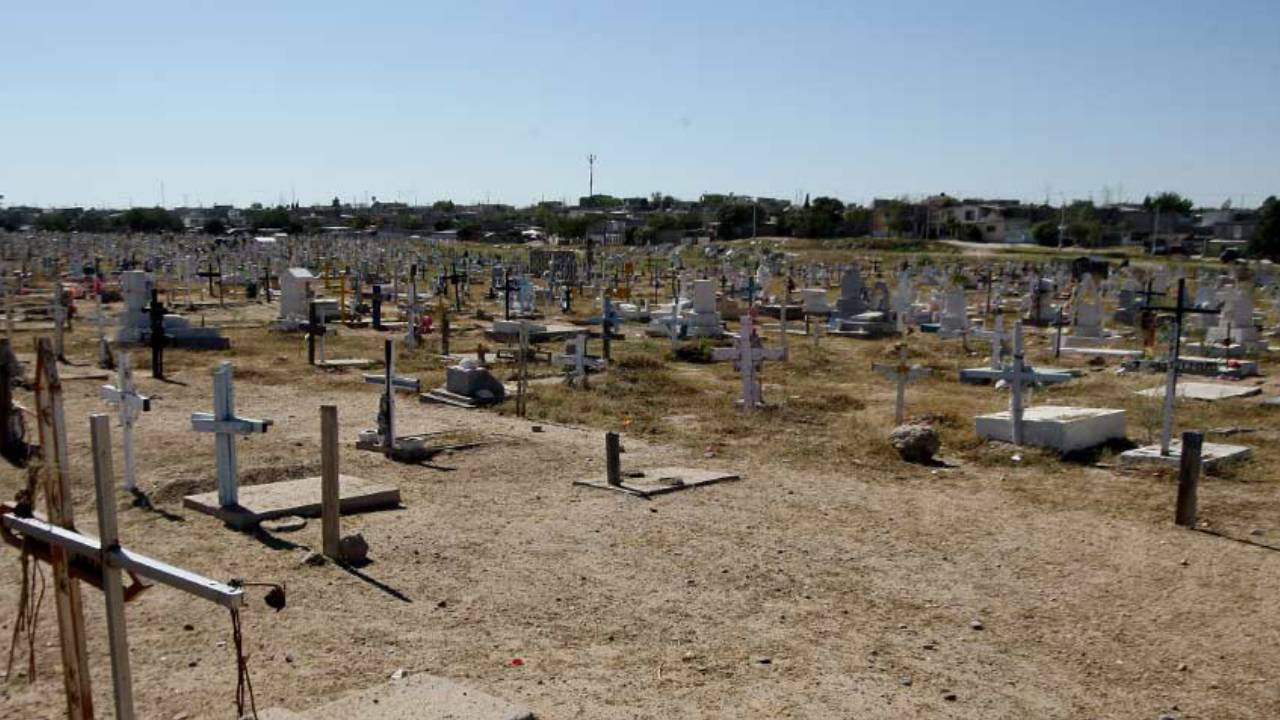
Located in what was once part of the Valle de Juárez agricultural area, this small, largely abandoned burial ground sits amid modern residential developments near Boulevard Francisco Villarreal Torres (close to its intersections with Boulevard Juan Pablo II or Cuatro Siglos), along or near Calle Camino a Barcelona / Vereda Segovia in the Parcelas Ejido Jesús Carranza area. It is essentially open terrain with no perimeter fence or formal entrance, overgrown with weeds, and easy to overlook until you notice the crosses, mounds, and weathered markers.
History of the Cemetery
Unlike the larger municipal cemeteries such as San Rafael or the historic Panteón San José (tied to the old mission), Senecú developed organically as a practical burial place for families from the surrounding ejidos and rural settlements. People used it for decades as an alternative to more distant or formal government-administered cemeteries. Use appears to date back at least to the early 20th century, with activity intensifying around the Mexican Revolution era and continuing well into later decades; some markers go back to the 1940s or earlier, while the most recent burials are often two decades old or more.
Estimates of the number of interments vary (roughly a hundred to several hundred), and while people of all ages rest here, a striking proportion of the visible graves belong to infants, children, and adolescents. Many markers are simple wooden crosses, small concrete forms, or eroded mounds; some still show names and dates, others have long since faded. The site has been gradually enclosed by urban growth—nearby neighborhoods of middle- and upper-middle-class housing now surround what was once open countryside—leaving the cemetery neglected, unsecured, and vulnerable to vandalism, dumping, and occasional illicit activity.
The Haunting Legends
Local lore has long labeled it the most “embrujado” (haunted) cemetery in the city. Residents of the surrounding colonias and visitors repeatedly describe the same core phenomena:
- At night, especially when the area is quiet, people report hearing children’s laughter, the sounds of play, or small voices among the graves.
- Silhouettes or small figures are said to run between the crosses and markers; some accounts claim these apparitions have been seen heading toward nearby houses, knocking on doors, and then vanishing.
- A popular “test” among those drawn to the paranormal involves parking a car nearby for a period (sometimes hours) and later finding small, muddy handprints on the vehicle’s body or windows—interpreted as the children reaching out to play.
- Toys, offerings, or other items are occasionally said to appear or shift on graves that previously had none.
- The site’s isolation and lack of oversight have also led to reports of occult activity: remnants of candles (including Santa Muerte imagery), animal remains, and other signs of rituals.
These stories circulate widely in local media, oral tradition, and among urban explorers. One more specific urban legend involves a young man named Antonio who supposedly entered at night out of curiosity, encountered a rolling ball and children’s voices/laughter, and met a tragic end—though this remains unverified folklore rather than documented fact.
Note that another older public cemetery, San Pedro (El Panteón Viejo), also carries strong associations with children’s spirits linked to historical tragedies such as the 1918 Spanish flu and later waves of hardship, including reports of laughter, footprints, toys appearing, and even photographic anomalies. However, popular accounts and local reporting most consistently single out Senecú / El Panteón de los Niños as the city’s premier haunted burial ground.
Atmosphere and Practical Realities
By day the place can feel simply forlorn and forgotten—dry ground, scattered markers, weeds, and the incongruous backdrop of modern houses. By night the combination of isolation, lack of lighting or security, overgrown terrain, and the weight of the legends creates a genuinely unsettling atmosphere. Real-world risks (trespassing on an unsecured site, potential criminal activity, poor footing, and the general hazards of certain areas of the city after dark) are repeatedly noted by locals and journalists; the paranormal stories coexist with these more mundane dangers.
Why It Endures
In a city with a complex and often violent history—revolution, border turbulence, economic upheaval, and waves of loss—the image of restless children playing among neglected graves resonates strongly. The cemetery embodies both personal tragedy (high infant and child mortality in earlier eras) and collective memory of rural communities absorbed by the expanding urban fabric. Whether one attributes the experiences to residual energy, grief, suggestion, or something more, the legends have made Panteón Senecú a fixture of Juárez’s darker folklore.
If you visit or research further, treat the site with respect: it remains a burial ground for real people, many of them children. Daytime observation from public areas is one thing; nighttime exploration carries clear practical and safety considerations that outweigh any thrill. The stories persist because they speak to something deeper about loss, memory, and the thin boundary between the living city and those it has left behind.
Sources:
Cano, Karen. “Panteón Senecú: el cementerio más ‘embrujado’ de Juárez.” Circuito Frontera, 13 May 2023, circuitofrontera.com/2023/05/13/panteon-senecu-el-cementerio-mas-embrujado-de-juarez/.
Bitto, Robert. “The Ghosts of Ciudad Juárez.” Mexico Unexplained, 4 Dec. 2025, mexicounexplained.com/the-ghosts-of-ciudad-juarez/.
“La ronda de los muertos en el cementerio de los niños.” Norte Digital, 25 Oct. 2022, nortedigital.mx/la-ronda-de-los-muertos-en-el-cementerio-de-los-ninos/.
“Panteones de Juárez ‘dan vida’ a colonias.” Netnoticias, 2 Nov. 2021, netnoticias.mx/juarez/panteones-de-juarez-dan-vida-a-colonias.
Ríos Medina, Laura. “¿Dónde está el Panteón de los Niños en Ciudad Juárez y cuál es su leyenda?” Azteca Ciudad Juárez, 1 Mar. 2026, aztecaciudadjuarez.com/viral-y/donde-esta-el-panteon-los-ninos-en-ciudad-juarez-y-cual-es-su-leyenda/.
“Leyendas de México: El Panteón de los niños, risas y siluetas macabras en Ciudad Juárez.” Radio Fórmula, 21 Aug. 2022, radioformula.com.mx/ciudadjuarez/Leyendas-de-Mexico-El-Panteon-de-los-ninos-risas-y-siluetas-macabras-en-Ciudad-Juarez-20220821-0039.html.
“El ‘panteón de los niños’ y las huellas de manitas marcadas con lodo.” El Diario de Juárez, 14 Aug. 2020, diario.mx/juarez/el-panteon-de-los-ninos-y-las-huellas-de-manitas-marcadas-con-lodo-20200814-1696609.html.
“Sobrevive panteón a la urbanización.” El Diario de Juárez, 31 Oct. 2022, diario.mx/juarez/2022/oct/31/sobrevive-panteon-a-la-urbanizacion-911297.html.


Comments
Post a Comment