October 8-Chupacabra
Published by Aaron Perez
Published: 10/8/2025
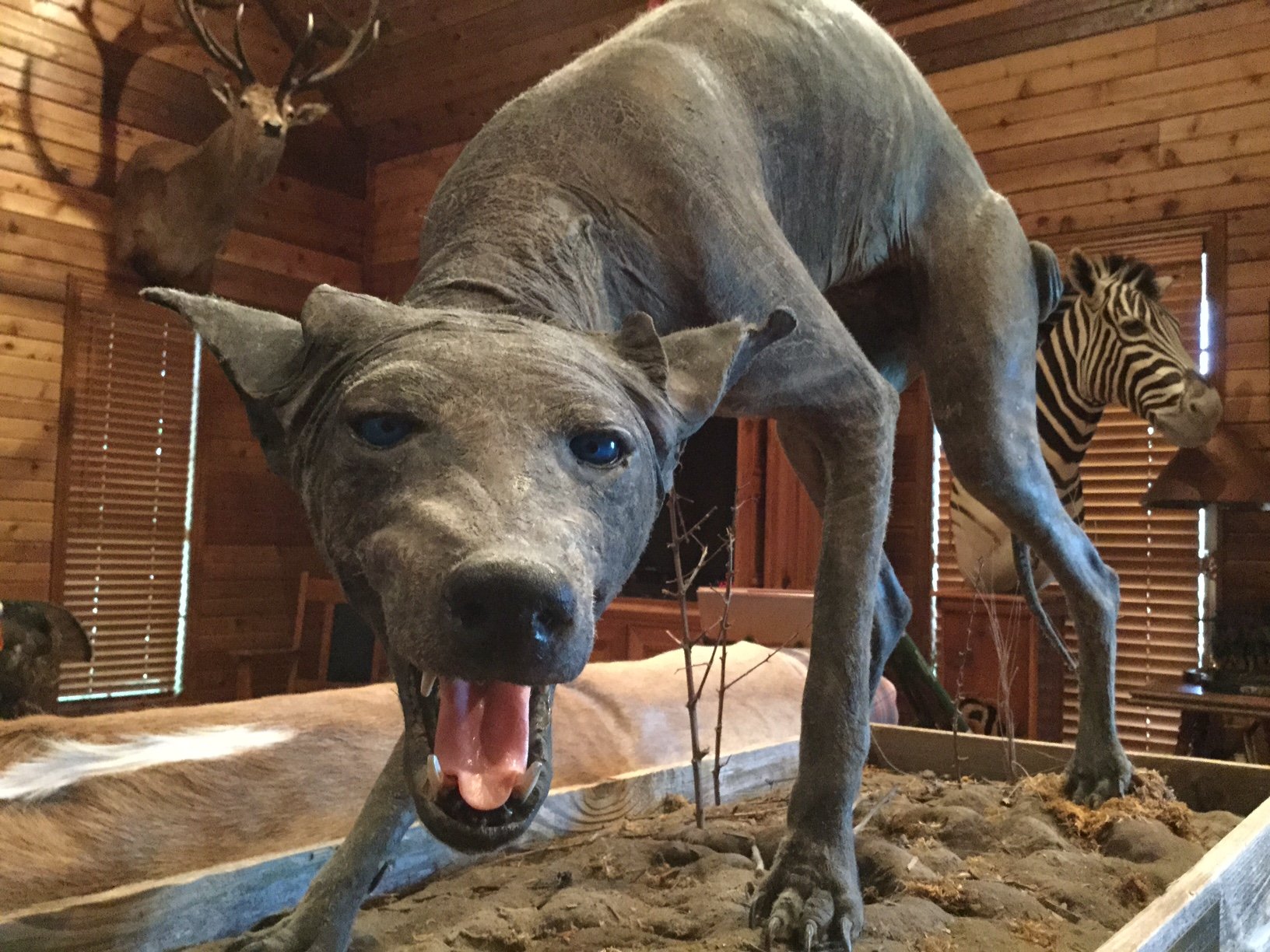
The Chupacabra, often translated as "goat-sucker" from Spanish, is a cryptid that has captured the imagination of people across the Americas. This elusive creature is said to prey on livestock, draining their blood through puncture wounds, leaving behind carcasses that baffle farmers and authorities alike. While skeptics dismiss it as a modern myth born from misidentifications and folklore, believers point to eyewitness accounts and unexplained animal deaths as evidence of its existence. The legend's roots trace back to Puerto Rico, but it has since spread northward, with notable sightings reported in Texas.
The Chupacabra legend emerged in Puerto Rico in 1995, amid a series of mysterious livestock killings. Reports began in March of that year, when farmers discovered animals—primarily goats, sheep, and chickens—dead with their blood seemingly drained through small, precise incisions. The first major incident occurred in the town of Canóvanas, where around 150 farm animals and pets were found exsanguinated. Eyewitnesses described a bipedal creature, about 3 to 4 feet tall, with reptilian skin, large red eyes, spines along its back, and sharp fangs—features that evoked images of an alien or demonic being.
The term "Chupacabra" was coined by Puerto Rican comedian Silverio Pérez, who used it humorously on his show, but it quickly caught on as the killings gained media attention. Some theories link the creature's appearance to the release of the sci-fi horror film Species in 1995, which featured a similar alien entity and was set partly in Puerto Rico near the Arecibo Observatory. Others suggest it draws from older Puerto Rican folklore involving vampiric entities, amplified by economic hardships and natural disasters like Hurricane Hugo in 1989, which may have displaced wildlife and led to unusual predation patterns. By the end of 1995, the Chupacabra had become a cultural phenomenon, spreading fear and fascination throughout the island and beyond.
The Chupacabra myth migrated to the United States mainland in the early 2000s, with Texas becoming a hotspot for alleged encounters. Unlike the reptilian descriptions from Puerto Rico, Texas sightings often portray the creature as a hairless, dog-like animal resembling a coyote or canine with mange—a skin condition caused by mites that leads to hair loss and a gaunt appearance. One of the most famous cases occurred in 2007 near Cuero, Texas, where rancher Phylis Canion found a strange, hairless creature dead on her property after her chickens were killed. The body, which she preserved, was later identified by experts as a coyote with severe mange, but it fueled widespread media coverage and dubbed Cuero the "Chupacabra Capital of Texas."
Subsequent reports have included video footage and trail cam captures. In 2008, a dashcam video from DeWitt County showed law enforcement chasing a similar hairless animal, sparking debates about its identity. In 2014, a family in Ratcliffe, Texas, claimed to have captured a live Chupacabra, describing it as a small, aggressive beast that they kept in a cage before it escaped. More recently, in 2019, security footage from Houston captured a mysterious, lanky figure prowling a neighborhood, which some likened to the legendary creature. Trail cam footage from rural Texas farmlands in 2025 purportedly showed a Chupacabra feeding on livestock, though skeptics argue it's likely a diseased fox or dog.
These Texas encounters often coincide with periods of drought or disease outbreaks among wildlife, leading to increased sightings of mangy animals scavenging near human settlements. While no concrete evidence has confirmed the existence of a new species, the legend persists, blending local folklore with modern cryptozoology.
From a scientific standpoint, the Chupacabra is widely regarded as a case of mistaken identity. The American Museum of Natural History attributes the Puerto Rican origins to livestock deaths possibly caused by feral dogs or parasites, exaggerated by media hype. In Texas, DNA tests on alleged Chupacabra corpses have consistently revealed them to be coyotes, dogs, or raccoons afflicted with sarcoptic mange. Despite this, the myth endures, influencing pop culture through books, films, and TV shows like Expedition X, which explored Texas sightings.
The Chupacabra represents more than just a monster; it's a symbol of the unknown, reflecting societal fears of the unnatural and the unexplained. From its humble beginnings in Puerto Rico to its adaptation in the American Southwest, this blood-sucking beast continues to lurk in the shadows of our collective imagination, reminding us that sometimes, the scariest stories are the ones we tell ourselves.
Sources:
"Chupacabra Caught on Camera in Texas Ranchlands." Facebook, 20 Sept. 2025, www.facebook.com/mostamazingtop10videos/videos/chupacabra-caught-on-camera-in-texas-ranchlands-chupacabra-texas-creature-myster/1524573148984307/.
"Chupacabra Revisited: Dueling Origin Stories of the Hispanic Vampire." Skeptical Inquirer, Center for Inquiry, 2025, skepticalinquirer.org/2025/04/chupacabra-revisited-dueling-origin-stories-of-the-hispanic-vampire/.
"Chupacabra: Puerto Rico's Legendary Blood-Sucking Beast." American Ghost Walks, 15 Feb. 2023, www.americanghostwalks.com/articles/chupacabra-puerto-rico.
"Chupacabras and Other Mysteries." Greenleaf Publications, 1997. Referenced in Skeptical Inquirer, skepticalinquirer.org/2025/04/chupacabra-revisited-dueling-origin-stories-of-the-hispanic-vampire/.
"Chupas Time-Line." Princeton University, www.princeton.edu/~accion/chupa21.html.
"El Chupacabra Mystery Origins Traced to 1995 Sci-Fi Film." The Christian Science Monitor, 22 Mar. 2011, www.csmonitor.com/Science/2011/0322/El-Chupacabra-mystery-origins-traced-to-1995-sci-fi-film.
"The First El Chupacabras Sighting Took Place in Puerto Rico in 1994." Facebook, PBS Digital Studios, 8 Oct. 2019, www.facebook.com/PBSDigitalStudios/videos/el-chupacabras-a-modern-mystery-monstrum/1508873919292615/.
"The Latin American Boogeyman: All About El Chupacabra." Amigo Energy, 10 July 2024, amigoenergy.com/blog/the-latin-american-boogeyman-all-about-el-chupacabra/.
"The Mystery and Truth Behind the Chupacabra." CBS Austin, 31 Oct. 2022, cbsaustin.com/news/local/the-mystery-and-truth-behind-the-chupacabra.
"The Mythical Creature Known as the Chupacabra Walked Out of a Movie." Office for Science and Society, McGill University, 30 June 2023, www.mcgill.ca/oss/article/critical-thinking-history/mythical-creature-known-chupacabra-walked-out-movie.
"Possible 'Chupacabra' Caught on Camera in Houston, Texas." ABC7 Chicago, 17 May 2019, abc7chicago.com/post/possible-chupacabra-caught-on-camera-in-houston-texas/5306299/.
"Texas Family Claims to Have Caught Chupacabra." YouTube, WKRC, 28 Apr. 2014, www.youtube.com/watch?v=-n9PaDnBKhk.
"TERRIFYING El Chupacabra Found Video Included | The Proof Is Out There." YouTube, 24 Dec. 2024, www.youtube.com/watch?v=CwJakDoNefY.
"Are the Strange Creatures Found Around Cuero the Legendary Chupacabra?" Texas Standard, 1 Nov. 2023, www.texasstandard.org/stories/cuero-texas-chupacabra-ranch-cryptid-sightings/.
"Chasing Chupacabras? You May Find Something Even More Extraordinary Here." National Geographic, 8 Nov. 2022, www.nationalgeographic.com/travel/article/chasing-chupacabras-you-may-find-something-even-more-extraordinary-here.
"Chasing the Chupacabra." The Texas Observer, 27 Oct. 2016, www.texasobserver.org/chupacabra-legends-texas/.
"Chupacabra." Wikipedia, Wikimedia Foundation, en.wikipedia.org/wiki/Chupacabra.
"What to Do If You See a 'Chupacabra' in Texas This Summer." KXAN, 17 June 2023, www.kxan.com/top-stories/what-to-do-if-you-see-a-chupacabra-in-texas-this-summer/.
"What to Do If You See a Chupacabra in Texas During the Summer." Midland Reporter-Telegram, 27 June 2023, www.mrt.com/news/article/chupacabra-sighting-texas-summer-18171836.php.


Comments
Post a Comment