October 6-Banshee
By Aaron Perez
Published 10/6/2025
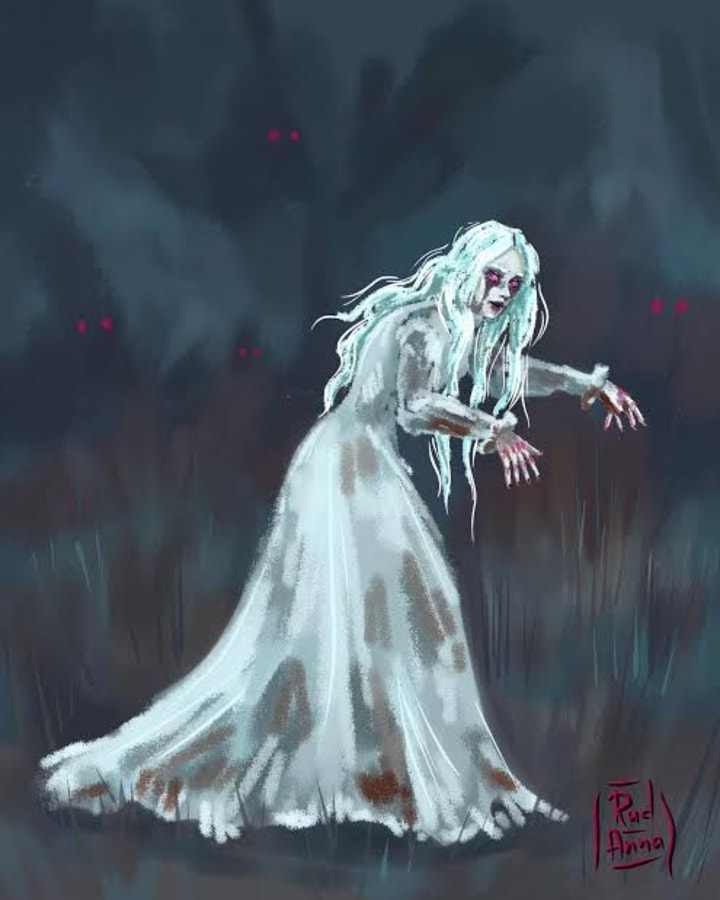
In the misty hills and ancient ruins of Ireland, where folklore weaves through the fabric of everyday life, few figures evoke as much dread and fascination as the Banshee. This supernatural entity, often depicted as a spectral woman whose mournful cry pierces the night, has been a staple of Irish myths for centuries. But what exactly is a Banshee, and why does her legend endure? Let's delve into the origins, characteristics, and cultural impact of this iconic figure from Gaelic folklore.
The Banshee, known in Irish as "bean sí" or "ban sídhe," translates to "woman of the fairy mounds" or "fairy woman." Her roots trace back to ancient Celtic traditions, where she is considered a member of the Aos Sí, the supernatural race akin to fairies or elves that inhabit the Otherworld. Legends suggest that the Banshee originated from the practice of keening—a ritualistic wailing performed by professional mourners, usually women, at funerals to lament the dead and guide their souls. This custom, deeply embedded in Irish culture, likely evolved into the myth of a spectral keener who foretells death rather than merely mourning it.
Historical accounts place sightings of the Banshee as far back as ancient times, with stories passed down through oral tradition. She is said to be the spirit of a woman who died young or violently, forever bound to wail for certain families. Notably, the Banshee is often linked to prominent Irish clans, such as the O'Neills, O'Briens, and Kavanaghs, appearing only to herald the demise of their members.
Descriptions of the Banshee vary, but she is universally portrayed as a female figure. In some tales, she appears as an ethereal beauty with long, flowing hair—red, black, or silver—clad in a green dress or gray cloak, evoking the image of a fairy queen. Other accounts depict her as a hag-like crone, withered and terrifying, with wild hair and eyes reddened from eternal weeping. She might be seen combing her hair with a silver comb near bodies of water or ancient sites, a motif that ties her to the liminal spaces between life and death.
Unlike malevolent spirits that cause harm, the Banshee is more of an omen than a threat. She doesn't cause death but announces it, serving as a messenger from the Otherworld. Her presence is tied to specific bloodlines, suggesting a familial or ancestral connection—perhaps the ghost of a long-deceased relative watching over her kin.
At the heart of the Banshee legend is her cry, known as the "caoine" or keening. This piercing wail, sometimes described as a blend of sorrowful song and anguished scream, is said to echo through the night when death is imminent. It's not just any death; the Banshee's lament is reserved for those of noble Irish descent or significant families, amplifying the myth's ties to heritage and lineage.
In some variations, her cry can be heard from afar, growing louder as death approaches. Witnesses report it as bone-chilling, capable of curdling blood and shattering glass. While terrifying, the wail is ultimately an act of compassion—a warning to prepare for loss.
The Banshee embodies themes of mortality, grief, and the thin veil between worlds in Irish culture. She reflects the Celtic reverence for ancestors and the supernatural, serving as a reminder of life's fragility. Over time, her legend has influenced literature, art, and media—from appearances in works by W.B. Yeats to modern horror films like The Banshee Chapter or video games where she manifests as a ghostly adversary.
In contemporary Ireland, while belief in the literal Banshee has waned, her story persists in folklore festivals, storytelling sessions, and even as a symbol in tourism. Some families still claim to have heard her cry in recent generations, keeping the myth alive in oral histories.
Whether viewed as a harbinger of doom or a poignant guardian spirit, the Banshee remains a captivating element of Irish mythology. Her enduring presence in stories reminds us of the power of folklore to connect us with our past. Have you ever heard a strange wail in the night? Perhaps it's just the wind—or maybe, just maybe, it's the Banshee calling.
Sources:
"Banshee." Wikipedia, Wikimedia Foundation, n.d., https://en.wikipedia.org/wiki/Banshee. Accessed 6 Oct. 2025.
Flynn, Shannon. "What Is a Banshee? The Mythic Origins of Ireland's Most Infamous Spirit." Irish Myths, 25 July 2022, https://irishmyths.com/2022/07/25/banshee/. Accessed 6 Oct. 2025.
"The Banshee." Folklore Scotland, n.d., https://folklorescotland.com/the-banshee/. Accessed 6 Oct. 2025.
McCarthy, Maeve. "In Search of the Irish Family Banshee, Her Cry Echoing Across Centuries." Smithsonian Folklife Magazine, Smithsonian Institution, 30 Oct. 2023, https://folklife.si.edu/magazine/irish-banshee. Accessed 6 Oct. 2025.
"Banshee | Irish Legend, Story and Folklore." YouTube, uploaded by Irish Myths, 1 Nov. 2023, https://www.youtube.com/watch?v=03S7j5SeRk8. Accessed 6 Oct. 2025.
"Exploring the Myths of Ireland's Legendary Creatures." US Ghost Adventures, 13 Mar. 2025, https://usghostadventures.com/uncategorized/exploring-the-myths-of-irelands-legendary-creatures/. Accessed 6 Oct. 2025.
"The Banshee." Emerald Isle, n.d., https://emeraldisle.ie/the-banshee. Accessed 6 Oct. 2025.
"The Legend of the Irish Banshee." Irish Jewelry Craft, 28 June 2024, https://www.irishjewelrycraft.com/blog/the-legend-of-the-irish-banshee. Accessed 6 Oct. 2025.
"Banshee." Encyclopædia Britannica, Encyclopædia Britannica, Inc., n.d., https://www.britannica.com/topic/banshee. Accessed 6 Oct. 2025.


Comments
Post a Comment