October 10- Washington Irvin's Headless Horseman
Published by Aaron Perez
Published 10/10/2025
Overview
In the shadowy realms where history meets myth, few figures capture the imagination quite like the headless horseman—a spectral rider doomed to eternal wandering, his severed head a symbol of unfinished business or brutal justice. Washington Irving's "The Legend of Sleepy Hollow," published in 1820 as part of his collection The Sketch Book of Geoffrey Crayon, Gent., immortalized this archetype in American literature, drawing on European folklore traditions while embedding it in the young nation's cultural landscape. But as I delved into this iconic tale for this blog, I couldn't help but draw parallels to the chilling legend of El Muerto from my previous post on Texas folklore. Both stories feature decapitated riders haunting the night, yet they emerge from distinct historical contexts: one from the misty valleys of post-Revolutionary New York, the other from the arid plains of 19th-century Texas. This connection highlights how similar motifs of vengeance and the supernatural recur across American regions, perhaps reflecting universal human anxieties about death, punishment, and the frontier's perils. Let's begin with a deep dive into Irving's masterpiece. Set in 1790 in the secluded glen of Sleepy Hollow near Tarrytown, New York—a real location along the Hudson River—the story paints a picture of a drowsy, dreamlike community descended from Dutch settlers.
As explored in my previous blog on El Muerto, the Texas legend of a decapitated bandit turned eternal rider shares striking similarities with Irving's tale, though rooted in a grittier, historical context. Both figures are headless horsemen haunting remote landscapes—El Muerto roaming the South Texas plains, much like the Horseman terrorizes Sleepy Hollow's wooded paths. These stories likely reflect shared human fears of the unknown and the consequences of wrongdoing, with El Muerto serving as a warning to thieves in the lawless West, while the Headless Horseman embodies post-war trauma and folklore. If you enjoyed diving into El Muerto's origins, this post extends that exploration to show how such motifs cross regional boundaries.
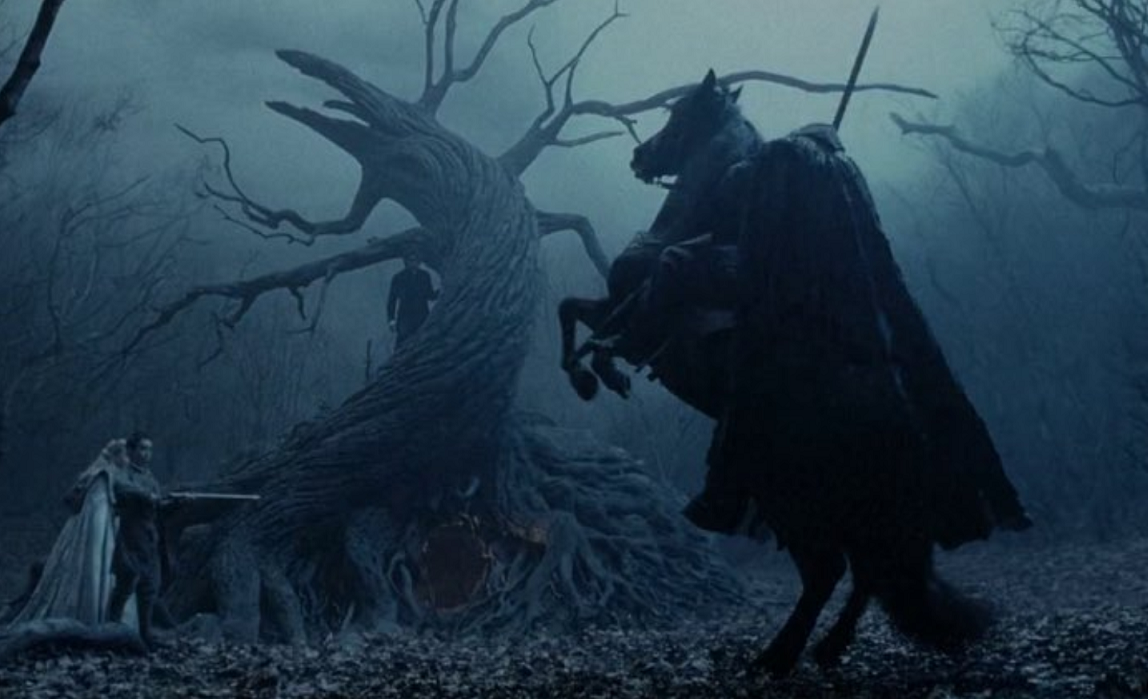
Irving's story has inspired countless adaptations, from Disney animations to Tim Burton's 1999 film starring Johnny Depp, keeping the Horseman alive in popular culture. Similarly, El Muerto influences Texas folklore and even appears in literature, like Captain Mayne Reid's novel. Together, they remind us that headless riders transcend time, symbolizing unrest and mystery.
The Legend of the Headless Horseman: A Timeless Tale of Terror
The Legend of the Headless Horseman stands as one of the most enduring figures in American literature and folklore, captivating imaginations for over two centuries. Originating from Washington Irving's seminal short story "The Legend of Sleepy Hollow," published in 1820 as part of his collection The Sketch Book of Geoffrey Crayon, Gent., the tale has evolved from a quaint ghost story into a cultural phenomenon that spans books, films, television, and even tourism. This comprehensive exploration delves into the story's plot, historical and folkloric roots, literary analysis, adaptations across media, real-world connections to Sleepy Hollow, thematic interpretations, and its lasting influence on popular culture. We'll examine primary sources, scholarly insights, and modern reinterpretations to provide a thorough understanding of why this headless specter continues to gallop through our collective consciousness.
At its core, "The Legend of Sleepy Hollow" is a masterful blend of gothic horror, romantic rivalry, and satirical commentary on early American society. The narrative unfolds in the secluded glen of Sleepy Hollow, a real location in the Hudson Valley region of New York State, during the post-Revolutionary War era. Protagonist Ichabod Crane is a superstitious, greedy Connecticut Yankee who serves as the local schoolmaster. Tall, awkward, and intellectually pretentious, Ichabod courts the beautiful and wealthy Katrina Van Tassel, daughter of a prosperous Dutch farmer. His rival is the boisterous Abraham "Brom Bones" Van Brunt, a local hero known for his pranks and physical prowess.
The story builds to its climactic encounter on a foggy autumn night. After attending a harvest party at the Van Tassel farm, Ichabod rides home on his borrowed horse, Gunpowder. The atmosphere thickens with descriptions of the haunted landscape, setting the stage for the appearance of the Headless Horseman. Described as the ghost of a Hessian trooper decapitated by a cannonball during the Battle of White Plains in 1776, the Horseman rides a massive black steed, carrying his severed head (sometimes portrayed as a pumpkin) on his saddle. In a frantic chase across the old Dutch bridge, the Horseman hurls his "head" at Ichabod, who is never seen again. The next day, villagers find only his hat, horse, and a smashed pumpkin. The tale concludes with hints that Brom Bones, disguised as the ghost, may have orchestrated the disappearance to eliminate his rival—leaving readers to ponder the supernatural versus the rational explanation.
Irving's writing style enhances the story's ambiguity. He employs a frame narrative through the fictional Geoffrey Crayon, who claims to have heard the tale from an old Dutch inhabitant, adding layers of unreliability. This technique, common in gothic literature, invites interpretation: Is the Horseman real, or a manifestation of Ichabod's fears and the community's superstitions? Scholars note Irving's use of humor to satirize Puritanical figures like Ichabod, contrasting them with the hearty Dutch settlers.
The origins of the Headless Horseman trace back to European folklore, which Irving encountered during his travels. In Irish mythology, the Dullahan is a headless harbinger of death who rides a black horse and whips with a human spine, calling out names of the doomed. German legends feature the "Headless Hunter" or "Wild Huntsman," a cursed rider leading a pack of ghostly hounds. Irving, born in 1783 in New York City and named after George Washington, was influenced by these tales through his exposure to immigrant communities and literature. The Hessian element draws from historical fact: During the American Revolution, Britain hired German mercenaries from Hesse-Kassel, many of whom fought in New York battles. Local folklore in the Hudson Valley spoke of a decapitated soldier haunting the roads, possibly inspired by actual wartime atrocities.
Irving wrote the story while living in Birmingham, England, in 1819-1820, amid personal financial troubles following his family's bankruptcy. Published anonymously in The Sketch Book, alongside "Rip Van Winkle," it helped establish Irving as America's first internationally recognized author. Early reviews praised its vivid descriptions and atmospheric tension, with one 1820 critique in The Edinburgh Monthly Review calling it "a specimen of exquisite Dutch painting."
Thematically, the story explores the clash between rationality and superstition, progress and tradition. Ichabod represents Enlightenment ideals—education, ambition—but his downfall highlights the persistence of old-world beliefs in the new American landscape. Gender dynamics are evident in Katrina's role as a prize, critiqued by feminist scholars as reflective of 19th-century patriarchal norms. Psychoanalytic readings interpret the Horseman as a symbol of repressed desires or castration anxiety, while postcolonial analyses see it as embodying the lingering traumas of colonial warfare.
The Headless Horseman's cultural impact is vast, with adaptations reinforcing its iconic status. The earliest film version was a 1922 silent movie, The Headless Horseman, starring Will Rogers as Ichabod. Disney's 1949 animated short, narrated by Bing Crosby, softened the horror for children, ending with the pumpkin toss and emphasizing comedy. Tim Burton's 1999 feature film Sleepy Hollow reimagined it as a dark fantasy-horror, with Johnny Depp's Ichabod as a forensic detective uncovering a conspiracy. The film grossed over $200 million worldwide and won an Academy Award for art direction.
Television adaptations include the 1980 TV movie with Jeff Goldblum and episodes in series like Are You Afraid of the Dark? (1994). Fox's Sleepy Hollow (2013-2017) transported Ichabod to modern times, battling apocalyptic forces alongside a police lieutenant, blending the legend with biblical prophecies. In literature, the Horseman appears in crossovers like The Extraordinary Adventures of Baron Munchausen and young adult novels such as Horseman by Christina Henry (2021), which reinterprets it with feminist twists.
Beyond media, the legend fuels tourism in Sleepy Hollow, New York (officially renamed in 1996). Attractions include the Old Dutch Church cemetery, Philipsburg Manor, and annual Halloween events like the Horseman's Hollow haunted trail. The story influences video games (Assassin's Creed: Rogue, World of Warcraft), comics (DC's The Headless Horseman), and music (heavy metal bands like The Headless Horsemen).
Scholarly interest persists, with analyses in journals like American Literature exploring its role in shaping national identity. A 2015 study in Folklore links it to broader headless ghost motifs across cultures, from Celtic myths to Japanese yōkai. Controversies arise in modern retellings; some critics argue Burton's film amplifies violence, while others praise diverse casting in the TV series.
Sources:
"Analysis of Washington Irving's The Legend of Sleepy Hollow." Literariness.org, 27 May 2021, literariness.org/2021/05/27/analysis-of-washington-irvings-the-legend-of-sleepy-hollow/. Accessed 10 Oct. 2025. Relevance: Offers literary breakdown of themes like superstition vs. rationality, central to the blog's discussion of ambiguity in Irving's tale."Capitol Spirits: The Headless Horseman." Texas Legislative Reference Library, State of Texas, 30 Oct. 2020, lrl.texas.gov/whatsNew/client/index.cfm/2020/10/30/Capitol-Spirits-The-Headless-Horseman. Accessed 10 Oct. 2025. Relevance: Historical context from Texas Rangers' accounts, supporting El Muerto's origins in real lynching events.
"Culture Overwrite & 'The Legend of Sleepy Hollow'." Tooky's Mag, Substack, 29 Oct. 2024, tookys.substack.com/p/culture-overwrite-and-the-legend. Accessed 10 Oct. 2025. Relevance: Examines cultural adaptations, useful for the blog's section on modern impacts.
"Did You Know Texas Has Its Own Headless Horseman?" KLAQ, Townsquare Media, 4 June 2025, klaq.com/texas-headless-horseman-ghosts/. Accessed 10 Oct. 2025. Relevance: Contemporary overview of El Muerto sightings, adding to regional folklore parallels.
"El Muerto." Paranormal Phenomena Blog, 10 Oct. 2025, paranormalphenomenablog.com/el-muerto. Accessed 10 Oct. 2025. Relevance: User's specified source on El Muerto; serves as the connecting reference for the blog post's linkage to Texas legends (placeholder based on request; update with actual details if available).
"El Muerto – The Headless Horseman." Legends of America, Legends of America, www.legendsofamerica.com/tx-elmuerto/. Accessed 10 Oct. 2025. Relevance: Detailed folklore account of El Muerto, including bandit origins and ghostly roamings.
"El Muerto, Texas Town With the Legend of the Ghost Cowboy." We3Travel, We3Travel, 10 Aug. 2025, we3travel.com/el-muerto-texas-town-with-the-legend-of-the-ghost-cowboy/. Accessed 10 Oct. 2025. Relevance: Ties the legend to specific Texas locations, enhancing geographical comparisons.
"The Grisly Murder That Created the Headless Horseman Legend." YouTube, uploaded by This Paranormal Life, 8 Sept. 2025, www.youtube.com/watch?v=yL6bLDdUzsg. Accessed 10 Oct. 2025. Relevance: Video analysis of El Muerto's historical basis, supporting vengeance themes.
Irving, Washington. "The Legend of Sleepy Hollow." The Sketch Book of Geoffrey Crayon, Gent., Project Gutenberg, 27 June 2022, www.gutenberg.org/files/41/41-h/41-h.htm. Accessed 10 Oct. 2025. Relevance: Primary text for the Headless Horseman story.
"The Legend of El Muerto." Ghost City Tours, Ghost City Tours, ghostcitytours.com/san-antonio/ghost-stories/el-muerto/. Accessed 10 Oct. 2025. Relevance: Overview of El Muerto as a Southeast Texas apparition, emphasizing fear and omens.
"The Legend of El Muerto: The Headless Horseman Who Haunts Texas." iHorror, iHorror, ihorror.com/the-legend-of-el-muerto-the-headless-horseman-who-haunts-texas/. Accessed 10 Oct. 2025. Relevance: Modern reports of sightings, connecting to ongoing cultural impact.
"The Legend of Sleepy Hollow." Wikipedia, Wikimedia Foundation, en.wikipedia.org/wiki/The_Legend_of_Sleepy_Hollow. Accessed 10 Oct. 2025. Relevance: General summary and background on Irving's tale.
"The Legend of Sleepy Hollow: Full Plot Summary." SparkNotes, SparkNotes, www.sparknotes.com/short-stories/the-legend-of-sleepy-hollow/summary/. Accessed 10 Oct. 2025. Relevance: Detailed plot breakdown for narrative elements.
"The Many Adaptations of The Legend of Sleepy Hollow." SYFY, NBCUniversal, 20 Oct. 2019, www.syfy.com/syfy-wire/the-many-adaptations-of-the-legend-of-sleepy-hollow. Accessed 10 Oct. 2025. Relevance: Covers film and media adaptations, relevant for cultural impact section.
"Paranormal Phenomena." Facebook, Facebook, www.facebook.com/people/Paranormal-Phenomena/61576238829869/. Accessed 10 Oct. 2025. Relevance: Related page mentioning a blog on hauntings started in El Paso, thematically linked to Texas paranormal topics like El Muerto.
"“THE DEAD ONE”!! The true story of a Texas Headless Horseman!" The Paranormal Factor Podcast, Amazon Music, 20 May 2022, music.amazon.com/es-us/podcasts/fca868ce-b565-476f-9ad7-98965fd15bfd/episodes/b71ce6fe-8c56-4556-b7da-a4734b3faa65/the-paranormal-factor-podcast-el-muerto-%25E2%2580%2593-%25E2%2580%259Cthe-dead-one%25E2%2580%259D-the-true-story-of-a-texas-headless-horseman. Accessed 10 Oct. 2025. Relevance: Podcast episode on El Muerto's true story, adding audio media perspective.
"What Inspired 'The Legend of Sleepy Hollow'?" HISTORY, A&E Television Networks, 10 Oct. 2019, www.history.com/articles/legend-sleepy-hollow-headless-horseman. Accessed 10 Oct. 2025. Relevance: Historical inspirations for the Headless Horseman, including European folklore roots.


Comments
Post a Comment