V2 Missile that hit Ciudad Juarez in 1947
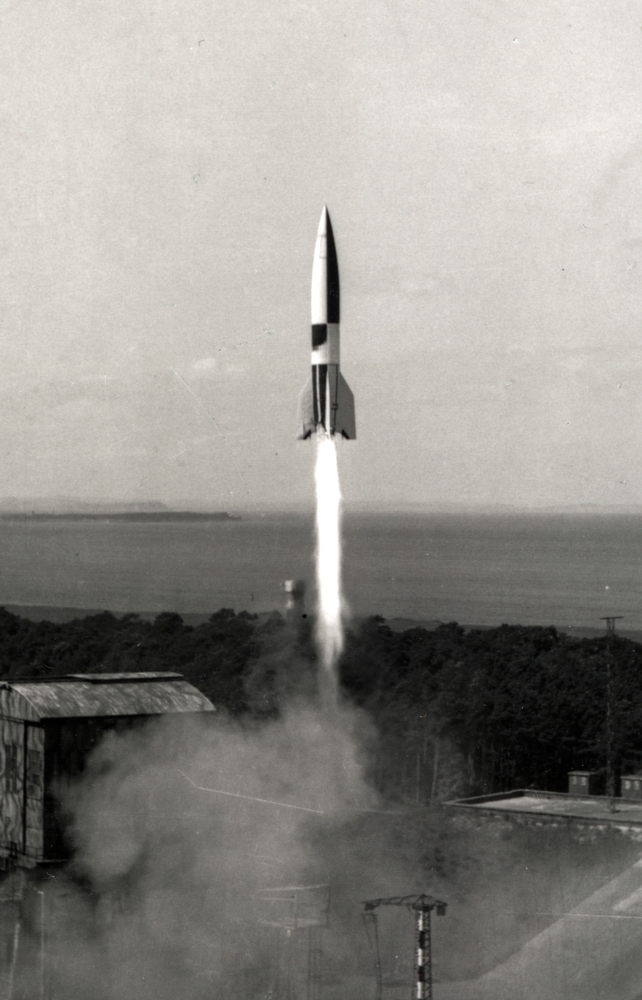
On the evening of May 29, 1947, a modified German V-2 rocket (part of the U.S. Hermes II program) launched from White Sands Proving Ground in New Mexico veered off course, flew over El Paso, Texas, and slammed into the ground near Ciudad Juárez, Mexico—close to what was then (and remains) Tepeyac Cemetery (Panteón Tepeyac / El Tepeyac).
The impact created a large crater in a then-sparsely populated rocky area roughly 3–3.5 miles south of Juárez’s business district and about half a mile south of the cemetery. No one was killed or seriously injured, but the blast rattled buildings across both cities, broke windows, stopped clocks, and briefly sparked panic and wild rumors of explosions or worse.
Background: Captured Rockets and Early Cold War Testing
After World War II, the United States brought V-2 rocket components and German scientists and engineers (under Operation Paperclip, including figures associated with Wernher von Braun’s team) to Fort Bliss and White Sands. Between 1946 and the early 1950s, dozens of V-2s and derivatives were assembled and test-fired there to gain experience with large liquid-fueled rockets, conduct high-altitude research, and develop follow-on systems.
The May 29 vehicle was a Hermes II (sometimes designated RTV-G-3 later), a modified V-2 intended as a testbed. It featured enlarged fins and was configured (though the ramjet payload was not active on this flight) to explore multi-stage and ramjet concepts. It was not armed with a warhead—only telemetry and instrumentation equipment—and weighed on the order of 4½ tons.
The Launch and the Mistake
Launch occurred around 7:30 p.m. local time from Launch Complex 33 after earlier delays and engine issues that day. The rocket was supposed to pitch north up-range into the proving ground. Instead, a guidance failure (commonly attributed to a German-made gyroscope problem or the inertial guidance system being wired backwards) sent it south.
It reached roughly 35–40 miles altitude, flew for about five minutes, passed over Fort Bliss and El Paso, and impacted near the Tepeyac area at high speed (reports cite around 12 miles per minute). The kinetic energy of the impact produced a crater approximately 50 feet wide and 24 feet deep and a concussion felt as far as Anthony, New Mexico, and Fabens, Texas. An electric clock in the El Paso sheriff’s office stopped at 7:32 p.m. Eyewitnesses described a mushroom-like flash of flames.
Range safety procedures of the era were immature. Accounts note that the range safety officer was prevented (in one version, physically restrained by a project scientist concerned about wasting propellant) from sending a destruct command once the vehicle went off course. Procedures were tightened afterward.
Aftermath and Local Impact
U.S. military personnel from White Sands and Fort Bliss quickly reached the site, apologized to Mexican authorities, paid for damages, and cleaned up the wreckage. Mexican soldiers helped guard the crater against sightseers and souvenir hunters. Local residents later recovered and sold scraps of metal. The area was relatively desolate at the time, which limited damage; the rocket also narrowly avoided more sensitive nearby sites (including reports of a powder magazine and proximity to an airport and oil facilities).
Contemporary headlines in the El Paso Times and other papers captured the drama: “V-2 Rocket, Of Course, Falls Near Juárez,” “V-2 Rocket Too Close For Comfort,” and similar. A later October 1947 incident involving a reported object near Guadalupe, Chihuahua, briefly revived concerns, though U.S. officials denied another V-2 launch.
One of the expatriated German team members is quoted in historical accounts with dark humor: to the effect that they were the first German unit to infiltrate the United States and attack Mexico from U.S. soil.
The Site Today
Tepeyac Cemetery (Panteón Tepeyac / El Tepeyac) still stands in the area. Local historical memory in Ciudad Juárez continues to mark the event—sometimes noting the crater’s former location adjacent to or near the cemetery grounds—and it remains a notable (if little-known internationally) episode in the shared border history of El Paso–Juárez and the early U.S. rocket program.
The incident illustrates both the promise and the hazards of the immediate postwar rocket era: rapid technological progress built on captured wartime technology, imperfect safety culture, and the very real possibility of international incident from a single guidance error. It was a dramatic near-miss that, by pure luck of geography and the absence of a warhead, ended without loss of life.
Sources:
“29 May 1947, 0130 GMT.” This Day in Aviation, 29 May 2026, www.thisdayinaviation.com/29-may-1947-0130-gmt/.
“1947: Off-course V-2 Rocket Just Misses Juárez.” El Paso Times, 12 Apr. 2016, www.elpasotimes.com/story/news/history/blogs/tales-from-the-morgue/2016/04/12/1947-off-course-v-2-rocket-just-misses-juarez/82893136/.
Cano, Luis Carlos. “Cohete lanzado en EU se impactó en Juárez.” El Diario, 31 Dec. 2019, diario.mx/juarez/2019/dec/31/cohete-lanzado-en-eu-se-impacto-en-juarez-516869.html.
“Duck and Cover!” StarDate, 29 May 2022, stardate.org/podcast/2022-05-29.
Eckles, Jim. “Two Crashes in Two Weeks: In 1947, Rockets Launched from White Sands Landed in Alamogordo, Juárez.” Las Cruces Sun-News, 15 May 2022, www.lcsun-news.com/story/life/2022/05/15/1947-rockets-launched-white-sands-landed-alamogordo-juarez/9740356002/.
Long, Trish. “Oops! White Sands Rocket Left Crater near Juárez Cemetery in 1947.” The Register-Guard, 31 Oct. 2019, www.registerguard.com/story/news/2019/10/31/ooops-white-sands-rocket-left-crater-near-juarez-cemetery-tales-from-the-morgue/2501778001/.
“The Hermes II Incident.” White Eagle Aerospace, 2 May 2011, www.whiteeagleaerospace.com/the-hermes-ii-incident/.


Comments
Post a Comment